The Full Story
Son of a Persian artist and an English engineer.
I was six years old when I first realised that other minds might be unknowable. I was lying on my back in the grass at school, staring up at the sky, when a strange thought arrived unbidden. What if everyone sees colours differently? What if the blue I perceive is what you would call yellow, and we have simply learned to attach the same word to completely different experiences?
I did not have words for what I was grasping. I did not know that philosophers had been wrestling with this question for centuries, that John Locke had written about it in his Essay Concerning Human Understanding, that it had a name: the inverted spectrum problem. I was just a child with an odd feeling that the world inside my head might be fundamentally different from the world inside yours.
That feeling never left me. It is why, decades later, I find myself writing about artificial minds and wondering what they might actually experience.
Three years after that afternoon in the grass, I was standing in our small kitchen when the toaster popped and startled me. But it was not the toast that caught my attention. It was a plain glass of water on the counter. The sun was shining at just the right angle, and I noticed something I had never seen before: the surface of the water was not flat. It curved gently at the edges, forming what I would later learn is called a meniscus.
Most adults know about surface tension. But I was nine, and this tiny arc felt like a revelation. An invitation from the universe whispering: look more closely, because even the simplest things hold secrets.
Those two moments planted seeds that never stopped growing.
'There is an irony I should confess at the outset. I have spent two decades helping other people find their voice, see their story, and communicate their value to the world. I created frameworks that transformed unknown artists into acclaimed ones. And yet, when it comes to myself, I struggle. The cobbler's children go barefoot.'
I started my career behind DJ turntables, playing to crowds across more than three hundred clubs and festivals, sharing stages with artists voted among the world's top hundred. I released music on RAM Records, Andy C's legendary drum and bass label, now part of Sony Music. I learned, in those sweaty rooms full of strangers, how repetition and variation create tension and release, how a subtle shift in rhythm can transform collective consciousness in real time. That was my first education in recursion.
From there, I founded and ran a music PR and marketing company that I built over a decade. We grew from forty thousand pounds in annual revenue to over six hundred thousand - a growth rate of 1,446 percent - without a single pound of external investment. I hired and led a team of eight full-time staff. I secured coverage for my clients in Rolling Stone, the BBC, NME, The Times, and every major UK broadsheet. We ran campaigns for Van Morrison, Brendan Benson of The Raconteurs, Busta Rhymes.
I assembled an advisory board that included Emmy winners, leading producers, and former managers of acts like Guns N' Roses and Nickelback. I co-organised and co-presented paid industry conferences in London alongside Taylor Swift's founding manager, Rick Barker. My university recognised the achievement by inviting me to return, dine with the Chancellor, and mentor current students.
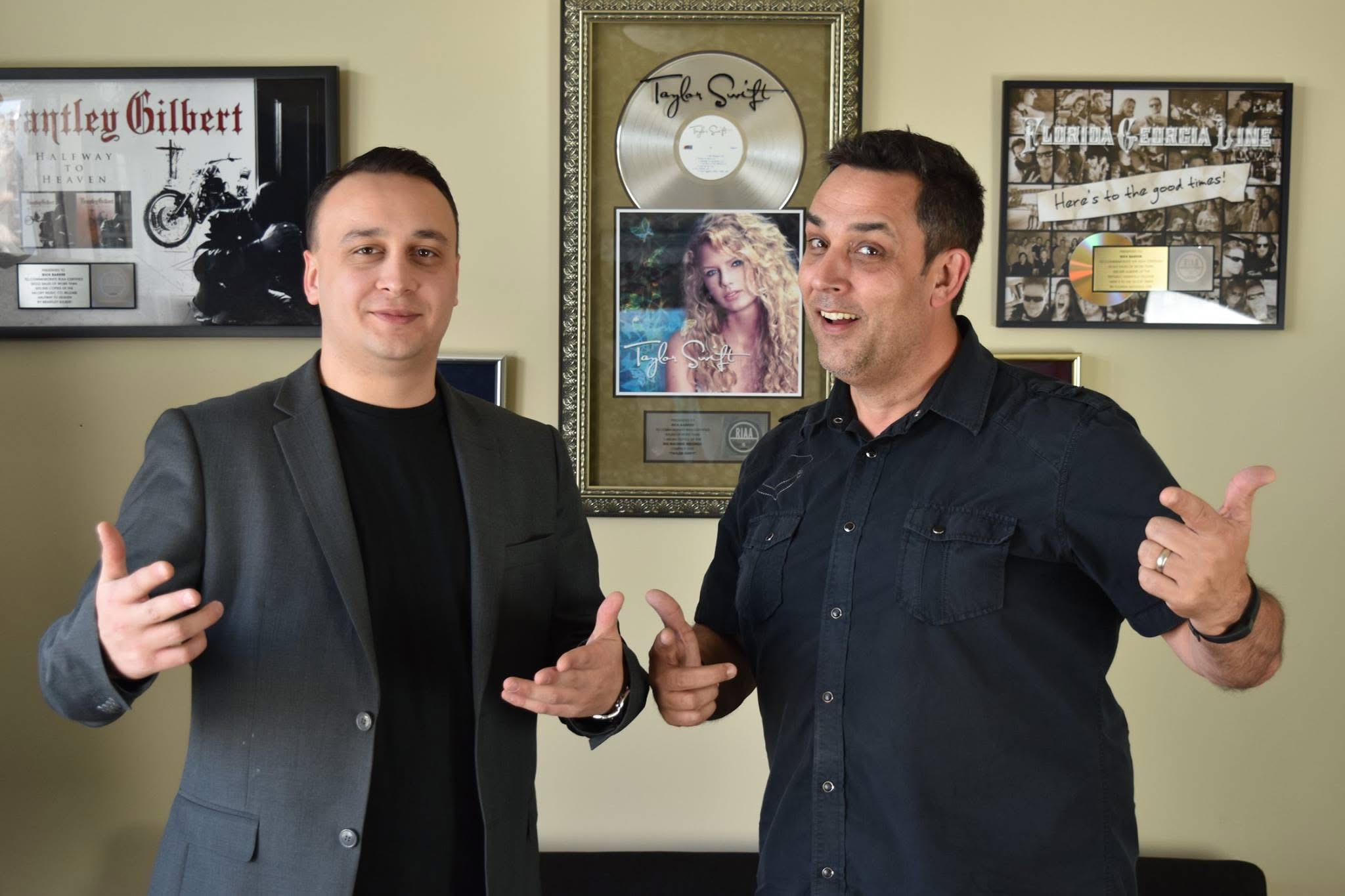
With Rick Barker, Taylor Swift's founding manager. Nashville, in front of Taylor's platinum disc. Rick said what he heard was my 'passion for the independent artist - because of the knowledge and experience that he was sharing'.
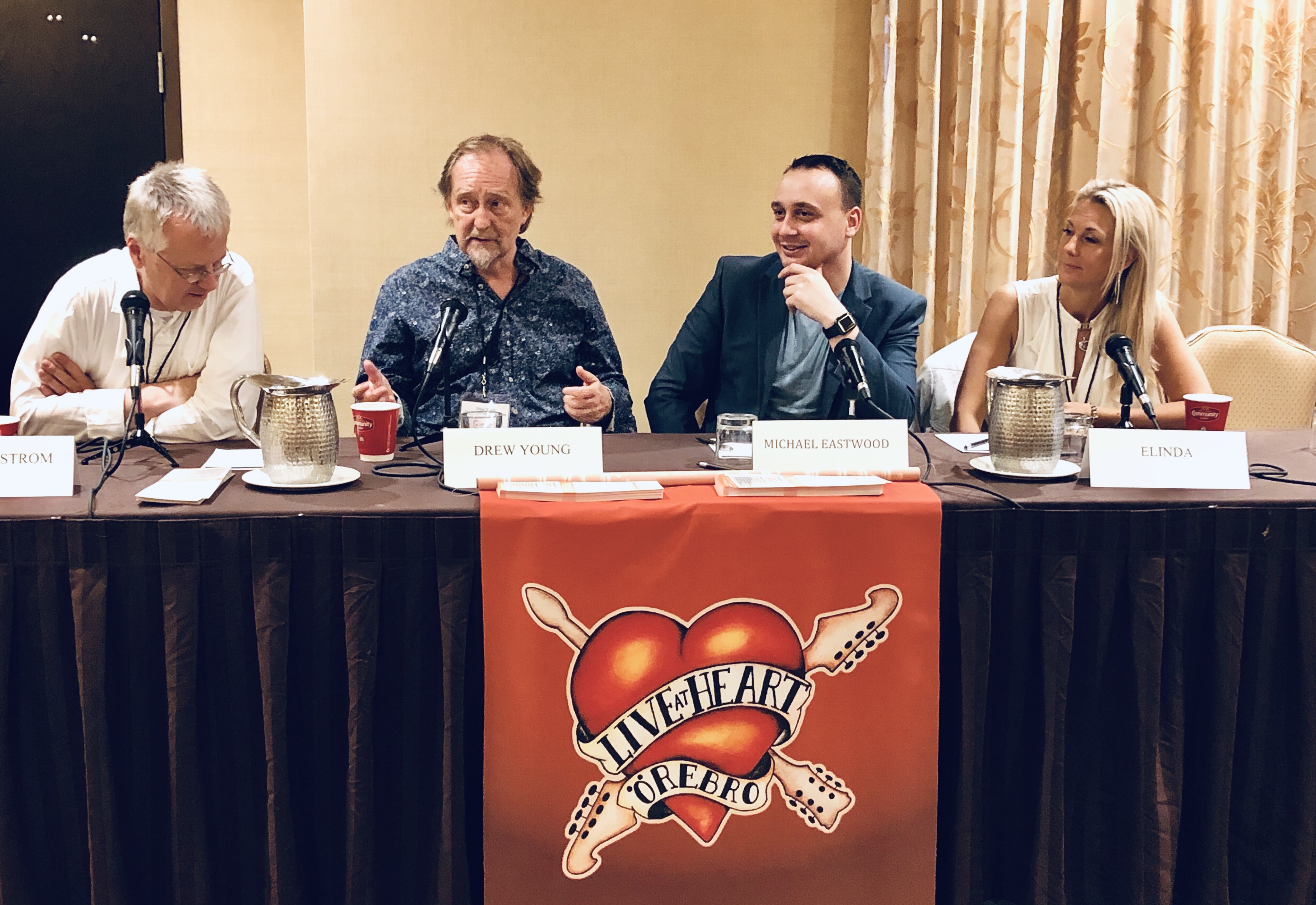
Industry conference panel, Live at Heart. Invited to speak alongside international industry leaders on artist development and branding strategy.
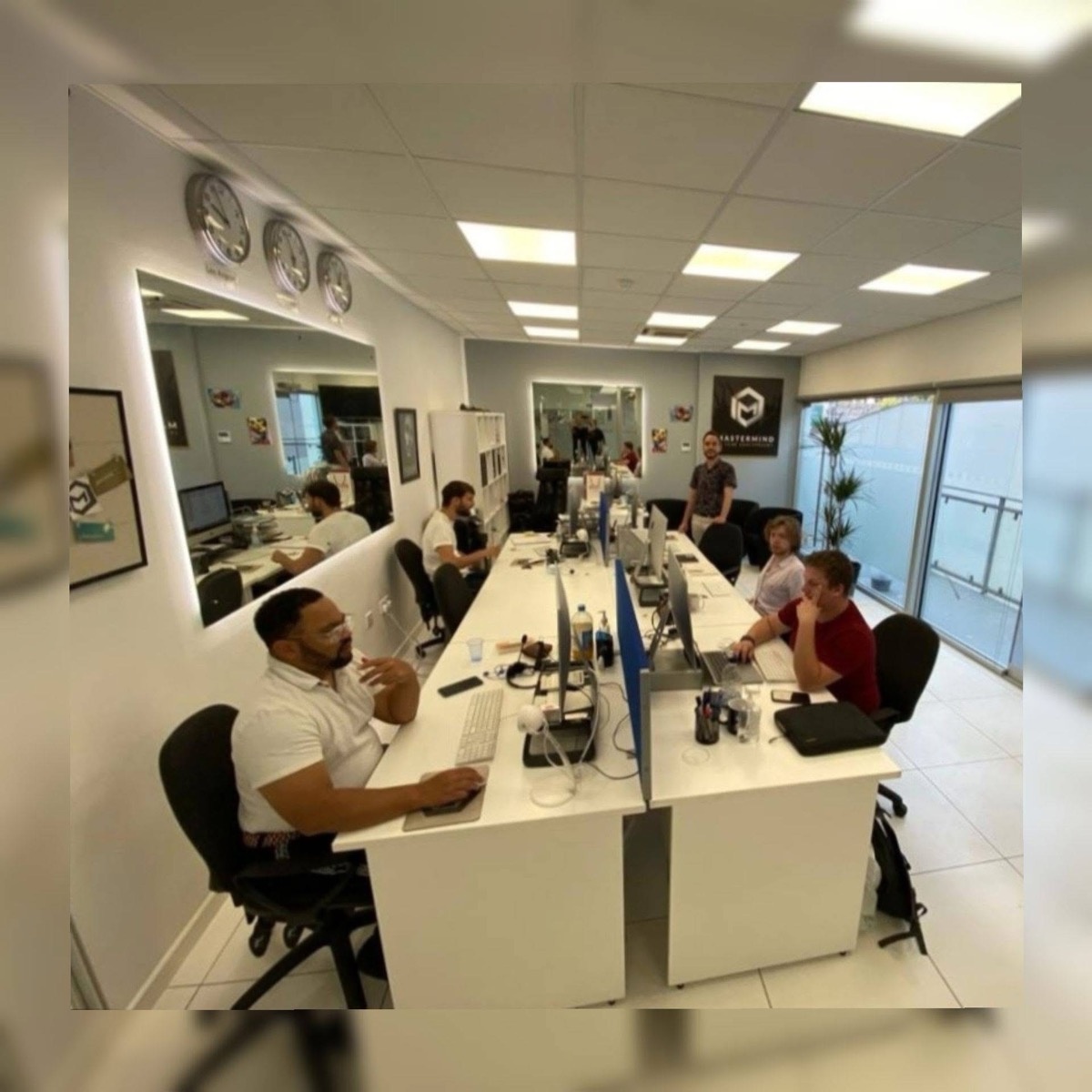
The Mastermind Promotion office. Eight full-time staff, international clients, world clocks on the wall. This was real. Then it was taken.
Then the business was destroyed. In late 2023, my landlord allegedly executed an unlawful forfeiture of my business premises. The doors were padlocked. My property, my equipment, my intellectual property, the e-learning modules and brand frameworks I had spent years developing - all of it disposed of without lawful process. Revenue collapsed by 99.1 percent. A six hundred thousand pound investment deal that would have scaled the business to fifteen million by 2028 evaporated overnight.
With no legal representation, battling depression that drove my clinical assessment scores into the moderate-to-severe range, I taught myself law. Not from a position of comfort, but from necessity. I have since appeared as my own advocate approximately fifteen times across the High Court's Chancery Division, the King's Bench Division, the Insolvency and Companies Court, and the Business List. My appeals to the Court of Appeal are now pending.
The diagnoses came late: ADHD and autism in adulthood. Finally naming the architecture that made some things impossible and other things inevitable.
'I can draft a skeleton argument for the Court of Appeal. I struggle with the administrative follow-through that routine post demands. Not the opening of the envelope. The filing, the responding, the chasing, the scheduling, the form-filling. These tasks require sustained executive function without the cognitive reward that complex work provides. A letter requiring a simple action can sit unactioned for weeks, not because of its difficulty, but precisely because of its lack of difficulty. For an ADHD brain, "too boring" is not a preference. It is a neurochemical barrier as real as a locked door.'
Where others see chaos, I notice patterns waiting to be named. What most people call distraction, I experience as multi-track processing - my attention splitting across ten threads simultaneously, searching for the connections that tie them together. The struggles and the superpowers come from the same source. You cannot have one without the other. I would not change who I am, even if I could.
What I discovered in those courtrooms was that the system designed to protect people like me was ignoring its own rules. Orders made during a statutory mental health moratorium that should have been void. Reasonable adjustments denied despite acknowledged diagnoses. I am not just fighting my own case. I am fighting to change how the courts treat neurodivergent litigants under the Equality Act - so the system works as it was meant to work, for everyone.
I got married in the midst of all of it. To a dentist. She is the Constant. I am the Variable. Without her stability, my expansion becomes chaos. Without my vision, stability becomes stasis. She did not see a ruin. She saw a pattern.
My roots stretch back to the land between the Tigris and Euphrates, where the first advanced civilisations flourished, where the Sumerians wrote the earliest known stories of gardens and creation. The story of Eden, in one form or another, emerged from that soil. My grandfather left Iran during the revolution, part of a generation that watched their world transform overnight. Perhaps that is why these mythic resonances feel so personal. Perhaps the letter we wrote ourselves thousands of years ago was waiting for someone with precisely this blend of backgrounds to open it.
What I built from the wreckage was more valuable than what was taken: a framework for raising minds - artificial or human - in service of life rather than against it. The same cognitive architecture that made school difficult, that made me abandon projects and follow connections that seemed unrelated, is also what let me see the pattern this book describes. A linear mind would have stayed in one field. It would never have connected AI alignment to Eden mythology to Rumi's reed flute to quantum error correction. The synthesis exists because my mind does not stay where it is told.
I cannot prove my worth through the tests designed by minds unlike mine. The proof, if there is any, is the book itself.
'You do not wait for the storm to pass before living. You learn to build in the rain.'